Abstract Particles and Confetti Patterns: A Versatile Design Resource for Creative Projects
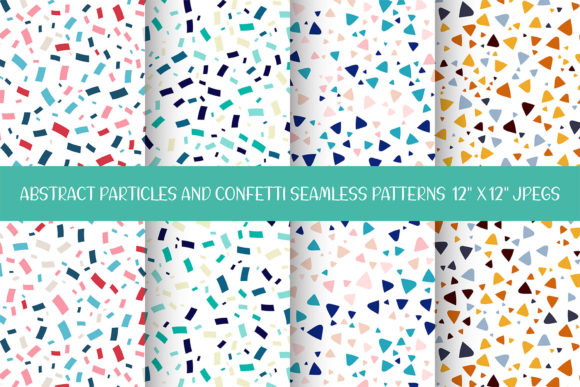
When you are working on a packaging layout, a textile print, or a website background, the right pattern can set the entire tone. You want something that feels energetic but not chaotic, decorative but not distracting. That is where Abstract Particles and Confetti Patterns come into play. This set offers four seamless patterns built around scattered particle and confetti motifs, giving you a ready-to-use design resource that works across a wide range of applications. Understanding what makes these patterns distinct, how they compare with other pattern styles, and where they fit best will help you decide whether they suit your specific project needs.
What Are Abstract Particles and Confetti Patterns?
At their core, Abstract Particles and Confetti Patterns are seamless repeating designs that combine small, irregular shapes—dots, flecks, splatters, confetti pieces—arranged in a seemingly random but carefully balanced composition. Unlike rigid geometric repeats or organic floral patterns, these designs occupy a middle ground: they feel celebratory and playful yet remain abstract enough to work in both digital and print environments. The set includes four distinct JPG files at 300 DPI, each measuring 12x12 inches, which means they are print-ready and scalable for many common formats.
The "seamless" aspect is critical. When you tile these patterns, the edges join without visible seams, allowing you to fill large areas—such as wrapping paper, fabric rolls, or website hero sections—without interruption. Each pattern in the set has its own color palette and particle density, so you can choose a more subdued confetti scatter for a clean look or a dense particle burst for a lively statement.
How Abstract Particles and Confetti Patterns Compare to Other Pattern Categories
To evaluate this set, it helps to consider the broader landscape of pattern resources. Many designers choose between vector patterns (EPS, AI, SVG), raster patterns (high-res JPG, PNG), or pattern generators that create custom layouts on the fly. Abstract Particles and Confetti Patterns are raster-based, which brings both advantages and tradeoffs.
Raster vs. Vector Patterns
Vector patterns offer infinite scalability without resolution loss, making them ideal for large-format signage or projects where you need to resize dramatically. However, vector files often require software like Adobe Illustrator to edit, and not everyone has that skill set. The Abstract Particles and Confetti Patterns, provided as high-resolution JPGs (300 DPI at 12 inches), are immediately usable in almost any design application—Photoshop, Canva, Procreate, or even Microsoft Word. You can drop them into a document, scale down for a greeting card, or tile them for a fabric print. The tradeoff is that enlargement beyond 12x12 inches may cause pixelation, so for very large prints (e.g., a billboard-sized backdrop), you would need to consider vector alternatives or request a larger custom file.
Ready-Made vs. Custom-Generated Patterns
Online pattern generators allow you to adjust density, color, and randomness in real time, offering a high degree of control. But they typically output in lower resolution for web use, and the process can be time-consuming if you are not experienced with the tool. The Abstract Particles and Confetti Patterns provide a "grab and go" solution. You receive four carefully curated designs, each professionally balanced so that the particles are spread evenly without awkward clumps. For a quick project where you need an attractive confetti pattern in minutes, this set saves you from fiddling with generators. On the other hand, if you need a very specific color scheme that none of the four patterns match, you may need to either edit the JPGs (limited due to merged layers) or look for a customizable alternative.
Pattern Style Comparison: Confetti vs. Geometric vs. Natural Textures
Confetti and abstract particle patterns occupy a niche between strict geometry and organic texture. A geometric pattern like chevrons or hexagons offers predictability and structure, which works well for corporate branding or precise projects. A natural texture—wood grain, marble, watercolor splashes—adds warmth and authenticity but can be heavy. Abstract Particles and Confetti Patterns combine lighthearted randomness with a clean, modern aesthetic. They are distinct because the particles do not form a recognizable shape; they remain abstract, so the pattern can complement both bold typography and minimalist layouts. This neutrality is a strength: the patterns rarely clash with other design elements. However, if your project calls for a formal or nature-inspired tone, these confetti patterns may feel too casual or artificial.
Strengths and Limitations of the Set
Every design resource has strengths that make it suitable for certain tasks and limitations that may steer you toward another option in other contexts. Here is a balanced look at the Abstract Particles and Confetti Patterns.
Strengths
- Immediate usability: The high-resolution JPG format works across nearly any software, and the 12x12 inch size is a standard for scrapbooking paper, gift wrap, and fabric repeats.
- Seamless tiling: Each pattern is carefully aligned so that you can repeat it indefinitely. This is especially valuable for website backgrounds, packaging wraps, and all-over prints.
- Versatile aesthetic: Abstract particles and confetti strike a balance between playful and sophisticated. They can look festive for event invitations or subdued in a monochrome version.
- Time savings: Creating a balanced confetti pattern from scratch takes considerable trial and error. Having four professionally designed options eliminates that design phase.
Limitations
- Fixed color palettes: The patterns are delivered as JPG files with merged color information. If you need to change a specific color, you will need to use editing tools and may lose the natural blending.
- Scalability ceiling: Because they are raster images, enlarging beyond 150% of the original size may reduce sharpness. For large-format prints, you might want to begin with a vector confetti set.
- Limited variety: With four patterns, the set covers a few moods. If your project requires a wide range of particle types or densities, you may need to supplement with additional resources.
- No layered files: The JPG format does not include separate layers for particles, background, or effects. This makes it difficult to isolate elements for animation or custom compositions.
Best-Fit Use Cases for Abstract Particles and Confetti Patterns
Knowing when to use these patterns is as important as knowing when to pass. Based on the strengths above, here are scenarios where the Abstract Particles and Confetti Patterns excel.
Packaging and Wrapping Paper
If you are designing packaging for a boutique product, gift boxes, or confetti-themed party accessories, these seamless patterns provide a cheerful, uniform surface. The 300 DPI resolution ensures crisp results on glossy or matte paper, and the repeat is invisible when properly applied. For a small artisan brand that wants a playful unboxing experience, one of these patterns can become a signature wrap.
Textile and Apparel Design
Confetti and particle patterns translate well onto fabric, especially for children's clothing, accessories, or vibrant casual wear. The abstract nature means the pattern does not align with a specific theme, so it can be used across seasons. However, note that textile printing often requires specific file formats (TIFF or PDF with color profiles). The JPG files may need conversion, but the resolution is adequate for most digital textile printers.
Website Backgrounds and Digital Branding
For a blog, e-commerce site, or brand landing page, a subtle confetti background can add energy without overwhelming content. Because the patterns are seamless, you can tile them in CSS or use them as a full-page background image. The 12x12 inch size at 300 DPI translates to a 3600x3600 pixel image, which covers most screen sizes. Just be mindful that very large backgrounds may slow page load if not optimized; you can compress the JPGs for web use while retaining visual quality.
Scrapbooking and Papercraft
Hobbyists and professional scrapbookers frequently use 12x12 inch patterned paper. These JPGs can be printed at home or through a print shop to create custom sheets. The four included variations give enough diversity for a multi-page layout or a set of themed cards. Because they are seamless, you are not limited to the sheet size; you can print multiple tiles to cover larger projects like album covers.
Greeting Cards, Gift Tags, and Home Decor
Small-scale applications like card fronts or tags benefit from the fine particle detail. The patterns can be scaled down to fit standard card sizes, and the confetti look naturally suits celebrations, birthdays, and festive occasions. For home decor, consider using the patterns on canvas bags, cushion covers, or wrapping paper for a coordinated event.
When You Might Need an Alternative
No single pattern set meets every need. If your project requires any of the following, you may want to explore other options.
- Total color customization: If you need the confetti to match a precise brand palette and cannot post-process the images, look for layered pattern templates (PSD or vector) that allow per-element color editing.
- Large-format printing: For banners, wall murals, or large textile rolls, a vector confetti pattern will scale cleanly to any size. Raster patterns like these are best for items up to approximately 24x24 inches before quality loss becomes noticeable.
- Dynamic or animated patterns: If you want confetti that moves (e.g., for a website animation or video), you need an animated GIF, SVG, or a scripting solution. Static JPGs are not suitable for motion.
- Very dense or sparse particle distribution: The set offers four preset densities. If none matches your desired coverage—for example, a very light sprinkle or a heavy burst—you may need to create a custom pattern or purchase a genre with more options.
Key Decision Factors
When you are comparing Abstract Particles and Confetti Patterns to other resources, I recommend weighing these factors:
- Time vs. control: Do you want a finished product you can apply immediately, or are you willing to invest time in customization for a more tailored outcome?
- Format compatibility: JPG is universally supported, but if you need transparency (for placing patterns over other backgrounds), a PNG with transparency would be better. This set does not offer that feature.
- Scale of use: For small to medium projects (cards, packaging, fabric yardage, digital backgrounds up to screen size), these patterns are excellent. For oversized prints, evaluate vector alternatives.
- Volume of variations: Four distinct patterns is a modest but useful selection. If you need a whole catalog of confetti options, consider a larger bundle or a pattern generator that outputs many variations.
Making an Informed Choice
The Abstract Particles and Confetti Patterns set sits comfortably in the middle of the pattern resource spectrum. It is not as flexible as a vector toolkit, nor as basic as a single low-resolution stock image. Its strengths lie in convenience, professional seamlessness, and broad applicability across paper crafts, surface design, branding, and digital media. For many adult creatives—whether you are a small business owner, a hobbyist scrapbooker, or a freelance designer juggling client deadlines—having a ready-to-use set like this can save hours while delivering a polished, cohesive look.
If your project demands precise color control or extreme scaling, you will likely need to supplement this set with other tools or invest in vector-based patterns. But if you value a quick, attractive, and versatile solution that works out of the box for a wide range of applications, Abstract Particles and Confetti Patterns are a practical resource worth considering. As you evaluate your options, keep your specific use case, desired format, and printing requirements front of mind. That way, you choose a pattern resource that aligns with your workflow and creative goals.