Exploring the World of Animal Skin Seamless Patterns: Design, Versatility, and Practical Use
Patterns have always been a fundamental element of visual communication and aesthetic expression. Among the most enduring and evocative motifs in design are those inspired by the natural world, particularly animal skin seamless patterns. Whether you are a graphic designer, a textile artist, a small business owner, or a hobbyist exploring new creative avenues, these patterns offer a rich blend of texture, elegance, and primal appeal. But what exactly makes them so valuable, and how can you use a collection of 10 animal skin seamless patterns in PNG, JPEG, and EPS formats across different projects?
This guide will take you from the basics of seamless patterns to the practical applications of a pre-made set. You will learn about the file formats, the industries that rely on such patterns, and how to integrate them into your own work—whether for branding, wrapping, scrapbooking, wallpaper, or textile design. By the end, you will have a clear understanding of why these patterns are more than just decorative elements; they are versatile tools for modern creativity.
What Are Animal Skin Seamless Patterns?
At its simplest, a seamless pattern is a repeating design that tiles infinitely without any visible seams, edges, or interruptions. When applied to a surface, it creates a continuous, flowing visual effect. Animal skin seamless patterns specifically draw inspiration from the natural markings found on animals—think leopard spots, zebra stripes, tiger streaks, giraffe patches, snake scales, or cheetah dots. These patterns mimic the organic, irregular beauty of animal coats while being digitally engineered to repeat flawlessly.
A high-quality pattern set typically includes multiple variations, each capturing a different animal's unique texture and color palette. The set you are considering offers 10 distinct designs, available in three widely used formats: PNG, JPEG, and EPS. This combination ensures that you can use the patterns across a range of software, from simple image editors to professional vector design tools.
The Formats You Need to Know: PNG, JPEG, and EPS
Understanding the difference between these file types is essential for getting the most out of your pattern collection. Each serves a distinct purpose and excels in different scenarios.
PNG (Portable Network Graphics)
PNG files are ideal when you need a transparent background. This makes them perfect for layering patterns over other designs, such as on a branding mockup, a scrapbooking page, or a website banner. PNG also supports high resolution, so your patterns remain crisp and clear even when scaled up. Because they retain transparency, PNGs are a go-to format for digital design work where the pattern needs to blend seamlessly with other elements.
JPEG (Joint Photographic Experts Group)
JPEG files are universally compatible and offer a good balance between quality and file size. They are excellent for quick previews, sharing with clients, or using in applications where transparency is not required. For example, if you are creating a wallpaper for a desktop background or a wrapping paper design that will be printed on a solid surface, JPEGs provide a reliable and easy-to-use option. The set includes high-resolution JPEGs so you can maintain visual fidelity in print and digital projects.
EPS (Encapsulated PostScript)
EPS is a vector format, meaning it is built from mathematical paths rather than pixels. This is the most powerful format for professional designers because it allows infinite scalability without any loss of quality. You can resize an EPS pattern to fit a billboard or a business card without any pixelation or blurring. EPS files are also editable in vector software like Adobe Illustrator or CorelDRAW, giving you the freedom to adjust colors, scale elements, or modify the pattern to suit your exact needs. For textile production, branding, and large-format printing, EPS is the industry standard.
Creative Applications Across Industries
Animal skin seamless patterns have moved far beyond their traditional association with fashion and interior decor. Today, they appear in a wide range of creative and commercial contexts. Here are some of the most common applications for a set of 10 patterns:
- Textile Design: Fabrics for clothing, upholstery, accessories, and home linens often incorporate animal motifs. Seamless patterns allow manufacturers to print continuously on yards of fabric, ensuring a uniform look without awkward interruptions. Whether you are designing a bold leopard print scarf or a subtle snakeskin accent pillow, these patterns provide a professional starting point.
- Branding and Packaging: Many brands use animal skin patterns to convey a sense of luxury, wildness, or sophistication. A premium cosmetic line might use a zebra stripe pattern on its packaging, while a boutique clothing label could incorporate a cheetah motif into its logo or wrapping paper. The EPS format lets you customize the colors to match brand guidelines.
- Wrapping Paper and Gift Bags: Animal patterns are popular for gift wrapping, especially for birthdays, baby showers, or themed events. With a seamless pattern, you can print your own wrapping paper at home or through a professional printer, creating unique and coordinated gift presentations.
- Scrapbooking and Paper Crafts: Hobbyists love using patterned papers to add depth and visual interest to scrapbook pages, cards, and journal covers. PNG files with transparent backgrounds can be layered behind photos or other embellishments, while JPEG versions work well as full-page backgrounds.
- Wallpaper and Murals: Interior designers frequently use animal skin patterns to create accent walls, feature murals, or full-room installations. Seamless patterns ensure that the design flows evenly across the wall without visible breaks. Digital wallpaper applications also benefit from high-resolution PNGs and JPEGs.
- Digital Assets: From website backgrounds and social media graphics to app interfaces and presentation templates, animal skin patterns add texture and personality to digital spaces. They can be used sparingly as accents or boldly as full backgrounds.
Why Seamless Patterns Matter in Design
The key advantage of a seamless pattern is its ability to create a cohesive, professional finish. Without seamlessness, repeating motifs often show visible lines or mismatched edges, which can ruin the illusion of a continuous surface. A well-made seamless pattern eliminates this problem, giving you a tool that can be applied to any size or shape without technical hiccups.
For designers, having a ready-to-use set of 10 animal skin patterns saves hours of manual work. Creating a high-quality seamless pattern from scratch requires careful alignment, color matching, and testing. A pre-made collection allows you to skip the tedious technical work and focus on the creative application. Moreover, the inclusion of vector EPS files means you are not locked into a fixed resolution; you can scale patterns up for large banners or down for small labels without losing detail.
From an educational perspective, studying these patterns also helps beginners understand the principles of repetition, symmetry, and tiling. By examining how the motifs are arranged, you can learn what makes a pattern feel natural and organic versus mechanical and forced.
A Closer Look at the 10-Pattern Set
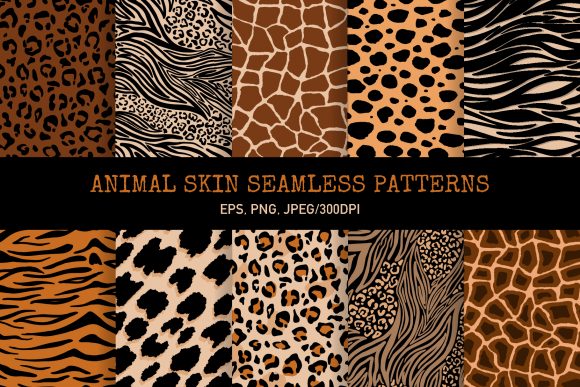
The specific set you are working with includes 10 different animal skin designs, each capturing a distinct texture and aesthetic. While the exact variations may differ, a typical collection might include:
- Classic leopard spots in warm brown and black tones
- Zebra stripes with bold black-and-white contrast
- Tiger stripes in orange and deep brown
- Giraffe patches with warm tan and dark brown shapes
- Cheetah dots in a sleek, modern palette
- Snake scales in neutral or metallic tones
- Cowhide patches in black and white
- Jaguar rosettes with intricate detailing
- Alligator or crocodile texture for a rugged look
- An abstract or hybrid pattern blending multiple influences
Each pattern is provided in all three formats: EPS for vector editing and scaling, PNG with transparency for layering, and JPEG for quick use. This variety ensures you have the right file type for every project, whether you are designing for print, web, or physical products.
How to Use Animal Skin Patterns in Your Projects
If you are new to working with seamless patterns, here are some practical tips to get started:
- Start with the EPS file for maximum flexibility. Open it in a vector editing program like Illustrator, Inkscape, or Affinity Designer. You can then change colors, scale the pattern, or even modify the individual motifs. This is especially useful for branding, where specific brand colors are required.
- Use PNG files for digital layering. If you are designing a website header, a social media post, or a digital scrapbook page, the transparent background of the PNG allows you to place the pattern behind text or images without ugly borders. Adjust the opacity in your design software for a subtle, sophisticated effect.
- Leverage JPEGs for quick mockups. When you need to show a client a rough idea or test a pattern on a product template, JPEGs are fast and easy to use. Most online mockup generators accept JPEGs directly, making them ideal for rapid prototyping.
- Print test samples. Before committing to a large production run, print a small sample to check how the pattern looks on your chosen material. Color can vary between screen and print, so it is wise to verify the final appearance.
- Mix and match patterns. The set of 10 patterns gives you a library to draw from. Use one pattern as a primary design and another as an accent or border. Because they are all seamless, you can combine them without worrying about alignment issues.
Common Misunderstandings About Seamless Patterns
Even experienced designers sometimes hold misconceptions about seamless patterns. Let us clarify a few:
- "Seamless means the pattern is invisible." No—seamless means the edge is invisible, not the pattern itself. The design repeats smoothly, but the motifs remain clearly visible. The goal is to hide the repetition, not the content.
- "All JPEGs are low quality." This is not true. A high-resolution JPEG (300 DPI or higher) can be perfectly suitable for printing. The key is to use a large enough file for your output size. EPS is still preferable for extreme scaling, but JPEGs can deliver excellent results for many applications.
- "Animal skin patterns are only for fashion." As we have seen, these patterns are used in branding, digital design, home decor, stationery, and more. They are versatile design elements that can be adapted to almost any visual context.
- "PNG is always better than JPEG." It depends on the use case. PNG offers transparency and lossless compression, which is great for digital layering. JPEGs have smaller file sizes and are more widely supported in certain contexts, such as online marketplaces or print-on-demand platforms that require JPEG uploads.
Final Thoughts
Animal skin seamless patterns are a timeless and practical resource for anyone working in design, crafting, or creative business. The set of 10 patterns in PNG, JPEG, and EPS formats provides a comprehensive toolkit that covers the most popular motifs while offering the flexibility to adapt them to your specific needs. Whether you are creating textiles, branding materials, wrapping paper, scrapbook layouts, or wallpaper, having these patterns at your fingertips saves time and elevates the quality of your work.
By understanding the strengths of each file format and the wide range of applications, you can make informed decisions that enhance your projects and impress your audience. The natural world has always been a source of inspiration, and with seamless patterns, you can bring that inspiration into your designs in a technically refined and endlessly reusable way.