Scandinavian Leaf Patterns for Digital Design
Few design styles manage to feel both timeless and fresh across so many applications. Scandinavian leaf patterns, with their clean lines, muted palettes, and organic motifs, have become a quiet workhorse for designers, bloggers, product creators, and marketers alike. Whether you are building a brand identity, designing printed stationery, or refreshing a blog layout, a well-crafted set of digital paper in this style can simplify decisions and elevate results. This article explores what these patterns offer, who benefits most, and how to use them effectively in real projects.
Why Scandinavian leaf patterns resonate across media
Scandinavian design is built on simplicity, function, and a deep connection to nature. Leaf motifs, in particular, bring warmth and rhythm without overwhelming a composition. Unlike florals that can feel ornate or tropical prints that demand attention, leaf patterns in the Scandinavian tradition offer a balanced middle ground. They add texture and interest while staying subtle enough to support text, branding, or product imagery.
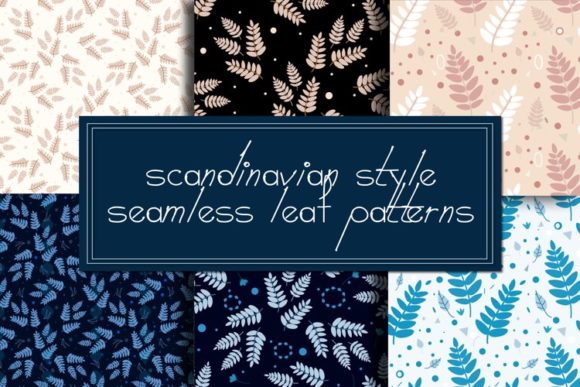
This balance makes them especially valuable for digital and print projects where clarity matters. A blog header, product label, or brochure background benefits from a pattern that enhances rather than competes. The six seamless patterns in this set are designed to repeat without visible breaks, which means you can apply them to large areas—wrapping paper, website backgrounds, social media templates—without awkward seams or distortions. Seamlessness matters because it saves editing time and preserves a professional finish from the first application.
What comes in the set and why each format matters
Understanding the file formats you receive helps you match the pattern to the task. The download includes six folders, each containing four format options: AI, EPS, PNG at 300 ppi, and JPEG at 300 dpi at 12x12 inches. Here is how each format supports different workflows:
- AI and EPS are vector formats. They allow you to scale the pattern up or down without losing resolution, which is critical for large-format printing, signage, or custom resizing. If you work in Illustrator or similar software, these files give you full control over colors, layering, and editing.
- PNG at 300 ppi preserves transparency, making it ideal for overlaying patterns on existing backgrounds, mockups, or layered designs. The high resolution ensures crisp output even when printed.
- JPEG at 300 dpi and 12x12 inches provides a ready-to-use raster file suitable for most print and digital applications. This format works immediately in programs like Canva, Photoshop, or even simple productivity tools where vector editing is not available.
Having all four options means you can move between tasks without converting files or losing quality. A packaging designer might use the EPS for scaling a pattern across boxes of different sizes, while a blogger might drop the PNG directly onto a post background. The same set serves both ends of the workflow spectrum.
Consistency across print and web projects
One of the biggest challenges in branding or content creation is keeping a consistent look across different platforms. When you use the same set of Scandinavian leaf patterns for a website background, a product tag, and a social media graphic, you create visual continuity that strengthens recognition. Because the patterns are seamless and come in matching scales, they behave predictably whether rendered on screen or printed on matte paper.
For a small business owner selling handmade goods or natural products, this coherence builds trust. Customers encounter the same clean aesthetic on the product label, the brand Instagram feed, and the thank-you card included in the package. That repetition, done tastefully, signals attention to detail and a clear brand identity.
Time savings without sacrificing quality
Starting a design from scratch takes hours. Even experienced creators spend significant time sourcing inspiration, testing tile-able patterns, and adjusting repeats. A pre-made set of seamless Scandinavian patterns removes that entire stage. You open the file, place it, and adjust size or color if needed. For a freelancer juggling multiple client projects, that efficiency translates directly to faster turnaround and lower overhead.
Entrepreneurs and marketers who do not have in-house design teams benefit similarly. Instead of commissioning custom patterned backgrounds for every campaign, you can reuse this set across seasonal promotions, product launches, or email newsletters. The style is neutral and nature-inspired, so it pairs well with most color schemes and typefaces.
Bloggers and web publishers
A blog about sustainable living, interior design, parenting, or wellness often benefits from visuals that feel calm and grounded. Scandinavian leaf patterns work as section dividers, background textures, or featured image overlays. They add visual depth without distracting from your written content. For readers who stay because the site feels pleasant to browse, that subtle design choice pays dividends in engagement and time on page.
If you run a WordPress site or a platform like Squarespace, the JPEG and PNG files drop directly into most page builders. You can upload a pattern as a block background or use it in a custom header section. The 12x12 inch size at 300 dpi also works well for printed blog planners, downloadable worksheets, or lead magnets that match your site's aesthetic.
Educators and hobbyists
Teachers creating classroom resources often need printable materials that look polished without being distracting. A leaf pattern border or background for a worksheet can make the material feel more inviting while keeping the focus on the content. Similarly, hobbyists designing scrapbooks, gift wrap, or personalized stationery benefit from patterns that print cleanly and coordinate with natural themes.
The vector formats are especially useful here because you can adjust the scale. A pattern meant for a 12-inch scrapbook page can be reduced to fit a bookmark or enlarged to wrap a gift box. That flexibility expands the set far beyond its original intended use.
Publishers and product creators
Small-run publishers—zines, poetry chapbooks, local guides—often work with limited budgets for design. Using a consistent pattern across covers, endpapers, and promotional materials gives the publication a cohesive identity without requiring a large design budget. For product creators who sell printable wall art, planners, or digital stickers, these patterns become a reusable asset that can be repackaged or combined with other elements.
Considerations when using digital paper patterns
No single design set fits every situation, and understanding the limitations helps you make better choices. Scandinavian leaf patterns tend to use restrained color palettes—soft greens, grays, muted blues, and off-whites. If your project demands high-contrast or very bold colors, you may need to adjust the pattern in a vector editor or combine it with other elements to increase visual impact.
Additionally, because the patterns are seamless and tileable, they work best as backgrounds, accents, or supporting elements. They are not intended to replace a central illustration or hero image. If you need a focal point for a poster or a landing page, consider using the pattern as a border or texture behind a strong type treatment or photograph.
For users who are new to working with pattern files, the AI and EPS formats require vector editing software. If you lack access to Illustrator or a comparable program, the PNG and JPEG files still cover most common use cases. Always check your software compatibility before starting a project, especially if you plan to edit colors or scale dramatically.
Getting started with your pattern set
Once you unzip the folder, take a few minutes to preview all six patterns. Notice how each leaf motif differs in density, orientation, and mood. Some patterns may suit a minimalist blog header, while others work better for a full-bleed brochure background. Having variety within one set allows you to match the pattern to the tone of each specific project without clashing styles.
Try layering a soft leaf pattern behind bold typography for a business card, or use a denser motif as the inside cover of a booklet. Test the patterns at different scales. A pattern that feels too busy at full size may become subtle and elegant when reduced to 50 percent. Conversely, a sparse pattern at larger scale can feel airy and open. The ability to adjust scale freely is one of the strongest arguments for choosing a vector-compatible set.
Finally, keep the files organized. Because each pattern includes four formats, six patterns add up to twenty-four files. Naming them clearly by pattern name and format (for example, LeafBranch.ai or LeafBranch.jpg) saves time when you revisit the set months later for a new project.
A practical addition to any design toolkit
Scandinavian Patterns, Digital Paper featuring leaf motifs is not a one-size-fits-all solution, but it addresses a specific need well: providing clean, repeatable, nature-inspired backgrounds that work across print and digital media. For professionals, entrepreneurs, and hobbyists who value efficiency without sacrificing aesthetic quality, having a dependable set of patterns reduces friction in the creative process. The formats offered cover the most common workflows, and the seamless construction eliminates a technical hurdle that often slows down production.
Whether you are designing for a brand, a blog, a classroom, or a personal project, these patterns offer a foundation that you can build on, modify, and reuse. Their strength lies in their restraint and versatility. In a design landscape that often favors the loud and complex, Scandinavian leaf patterns quietly deliver clarity, coherence, and calm.